
In 2011 there have already been a slew of remakes of familiar movie favourites. So it should come as no surprise Hollywood is returning to the well again to reboot silver screen classic Scarface. Unlike examples such as the critically maligned Straw Dogs or the panned Arthur however, it will be a completely re-imagined flick based on the original concept. Say hello to my little friend: Perhaps Tony Montana would be displeased at the news Scarface is going to be remade again Interestingly, while most people think of the 1983 version that starred Al Pacino as iconic Cuban anti-hero Tony Montana when they hear the title today, it is not the original. The 1932 first entry in the series was a seminal film in its own right, and is regarded as the more ground-breaking of the pair, holding a position as one of the first great talkies. It followed the exploits of Italian gangster Tony Camonte as he climbed the criminal underground ladder in prohibition era Chicago. According to Deadline Hollywood the new version will take the same basic concept, in which an immigrant outsider barges his way into the criminal establishment, but have a new distinctive story. Gunning for revenge: And maybe Tony Camonte would not to too happy either He will then become a kingpin through his own ruthlessness and brutality, but will be brought down by his flaws and weaknesses. Specifics about the new main character are being kept under wraps, but no doubt his origin and background will be as vital to the new story as in the previous versions. Universal Pictures is developing the project, and has reportedly been tasking writers to script a take for a film that will be produced by the company's former chairman Marc Shmuger and heavyweight Martin Bregman. Good business: Legendary Martin Bregman and Marc Shmuger are producing The latter produced the Pacino version, as other key hits in the legendary actor's career such as Serpico, Carlito's Way and Sea Of Love. The decision to remake the movie will no doubt draw howls of derision, although the Brian De Palma remake also drew a lot of criticism at the time because the original is considered a cinematic classic. The original picture was produced by colourful mogul Howard Hughes, and followed the exploits of the insanely violent gangster Camonte as he claws his way to top. Original and (arguably) best: The poster for the classic first film It starred legendary actor Paul Muni in one of his breakthrough roles, which led to a storied career that would see him win an Oscar and be nominated for five others. The film's second lead George Raft became a professional success thanks to his role as Camonte's best chum Guino Rinaldo, with his character's trait of habitually flipping a coin becoming a classic reference. After the original ending was deemed too violent by censors, Hughes funded a new one, but when it was still deemed too violent he had the original put back in and showed it in more lenient states in the US. The De Palma version charts the life of Montana, as the Cuban refugee rises from the bottom to become a cocaine kingpin in Miami. It contains iconic cinema moments including Al Pacino sniffing away at a small mountain of cocaine on his desk as he prepares for a final shootout with gangster rivals.
Thursday, 22 September 2011


Tears at family farewell to slain gangster Panda
THE mother and girlfriend of slain gang boss 'The Panda' wept last night at his removal mass. More than 100 people turned out to mourn notorious criminal Michael 'Micka' Kelly, who was gunned down in broad daylight as he left his girlfriend Caoimhe's apartment in Clongriffin last week. Silence surrounded St Benedict's church in Kilbarrack yesterday evening, as the 30-year-old's remains were brought inside. There was a strong garda presence outside the church with officers on high alert given the gangster's serious criminal connections. During a service that lasted fewer than 10 minutes, parish priest Fr David Lumsden spoke of the "horrific" effect the death had on Kelly's family. "This has been a horrific time for you as a family. And we know even to this day that there was a little gap to when he died but it is still a great shock to the family." At no point did the priest speak about the victim, or mention his criminal past. Following the service, he privately offered his condolences to Kelly's mother Ann and the rest of his family. His distraught partner Caoimhe was visibly upset as she held her son -- the baby boy who Kelly had come home to see before he died in a hail of bullets. Gardai maintained a strong presence outside the church to ensure the mass passed off peacefully. The father-of-three's execution has been dubbed the most significant gangland killing since the shooting of Eamonn 'The Don' Dunne outside the Faussagh House pub in Cabra on April 23 last year. Gardai were today expected to mount a much larger operation in anticipation that some of Kelly's criminal associates would attend. It has emerged that two gunmen used an AK47 assault rifle to shoot the gangsterat 1.15pm last Thursday afternoon. Kelly -- who made a fortune from drug dealing -- is understood to have a major property portfolio which includes apartments in Dubai and Spain. He had spent most of the last year living in Spain's Costa-Del-Crime but had returned home in recent weeks after his girlfriend gave birth to a baby boy, the thug's third child. Gardai believe Kelly's murder was well planned and that his killers had very accurate information about his movements. They suspect that a former bank worker and close associate of Kelly, known as 'Jewie', was with him when he was killed. Officers were working on the theory that pals of drug dealer Anthony Foster -- murdered by the Panda's mob in 2008 -- enlisted the Real IRA to carry out yesterday's murder. Less than an hour after he was shot dead and his body driven over, the home of a female associate of Foster was raided by armed detectives. No arrests have yet been made.
Hulking gangster Frank "Frankie Steel" Pontillo complains to judge that he can't avoid mobsters on Staten Island
Poor Frankie. A whiny wiseguy told a federal judge that he wants to stay clear of the criminal life, but it's just too tough while living on Staten Island, what with all the mobsters everywhere. Frank "Frankie Steel" Pontillo made the statements at a sentencing in Brooklyn federal court -- before the same judge he asked leniency of because the FBI traumatized his Yorkie puppy during a January 2010 raid. The Daily News reported the Wednesday exchange between Pontillo and Judge I. Leo Glasser: "I didn't invite the Five Families to gather at the opening of a bar," said Pontillo said, referring to On The Rocks, where, the paper reports, he runs the grill. "Staten Island is very small. There's lots of felons on the island... Every time I go somewhere, I see someone from my past." Glasser responded, "That's a problem with people who grew up in Bensonhurst or Staten Island, spent a good part of their life in prison... People they've known actually their whole adult life [are] convicted felons and members of one organized crime family or another." Pontillo, 41, was arrested back in January 2010 as part of a 100-suspect takedown. His part was buying stolen TVs and electronics from an FBI informant in New Jersey. In a July letter to Glasser, Pontillo's lawyer, George A. Farkas, described the raid: "It was an otherwise tranquil winter morning at about 6 a.m.... when several black SUVs, 2 unmarked minivans and other similarly ominous vehicles converged upon Frank Pontillo's snow covered home." After a further description of the "elite forces" present, Farkas continues: "In an operation worthy of an honorable mention next to the recent and well-publicized Navy SEAL commando raid in Pakistan, the front door of the Pontillo home was blown off its hinges. Then, percussion grenades were tossed into the home, the resulting blast propelling a 4 pound puppy across the room into a wall... The little dog has not been the same since." Farkas pleaded that Glasser not subject his client to supervised release: Pontillo's "weakness" means he'd slip up sooner or later and violate the terms of that release. "It is not hyperbole to suggest that he will serve a life sentence on an installment plan," Farkas wrote. Nevertheless, Pontillo ended up getting six months house arrest and two years of probation. Pontillo was convicted on murder conspiracy in 1993 -- he and four others hatched a scheme to dress as Hasidic Jews in an aborted plan to gun down William (Wild Bill) Cutolo during the Colombo crime family's civil war.
Wednesday, 21 September 2011
Ecstasy crime ring smashed,
highly sophisticated drug ring has been smashed by federal authorities with the seizure of a record haul of a precursor drug capable of producing $70 million worth of ecstasy. Customs intercepted more than 2800 litres of safrole oil (an extract of the sassafras plant) in three shipments from China to Sydney's Port Botany between April and August. The oil was concealed in bottles labelled as shampoo and cleaning products. Advertisement: Story continues below In a joint statement, the Australian Federal Police (AFP) said there was enough of the banned chemical to produce almost 235kg of MDMA or 2.3 million ecstasy tablets. Three Australian men were arrested during an operation involving more than 50 Australian Federal Police officers in Sydney on Wednesday morning. If found guilty, they face up to 25 years in jail and fines of up to $550,000. "We're not here to play. We're here to do as much damage to these people as we possibly can," AFP Assistant Commissioner Kevin Zuccato told reporters. "This is a significant blow, as far as I'm concerned, a lethal blow to this particular syndicate." Mr Zuccato said the haul was the largest in Australia and showed a highly organised crime ring was at work. "When you look at the sophistication of this syndicate ... there was no backyard lab," he said. "This was going to be a very sophisticated, super-lab as far as I'm concerned." Investigations into the syndicate were continuing and more arrests were possible, he added. Customs spokeswoman Michele Harper said the investigation demonstrated the effectiveness of Australian law enforcement in detecting even the most sophisticated drug concealment methods. "Customs and Border Protection continues to adapt its technology, and targeting and examination capabilities to counter the evolving methods used by drug importation syndicates," she said. A 27-year-old man from Lurnea and a 35-year-old man from North Parramatta were charged with importation of a commercial quantity of a border-controlled drug. A 33-year-old man from Merrylands was charged with dealing in the proceeds of crime. All three are expected to appear in Sydney's Central Local Court on Thursday.
Tuesday, 20 September 2011
Three women held for drug smuggling bid
Three women were arrested at Dubai International Airport attempting to smuggle narcotics into the country. Dubai Police's General Anti-Narcotics Department officers on duty at the airport were alerted by the suspicious behaviour of the three African women. Two of the suspects denied anything to do with narcotics despite checks to confirm the same but the third confessed she had swallowed capsules containing narcotics. A total of 2.044 kg of cocaine concealed in 184 capsules was recovered from the women.
Venezuela deports 6 suspected drug traffickers
Venezuela deported six suspected drug traffickers wanted in Colombia and the United States on Monday, touting the action as proof the government is making strides in fighting smuggling. Those deported included two accused of belonging to Colombia's largest leftist rebel group. They also included a U.S. citizen, Lionel Scott Harris, who is suspected of smuggling drugs to the United States, Asia and Europe. Harris, 67, was captured in March on Margarita Island, a popular tourist destination. Venezuela is a major hub for gangs that smuggle Colombian cocaine, and U.S. officials have accused President Hugo Chavez's government of being lax in anti-drug efforts. Last week, President Barack Obama's administration classified Venezuela as a country that has "failed demonstrably" to effectively fight drug trafficking. Justice Minister Tareck El Aissami dismissed that accusation, saying the U.S. has been spreading "pure lies" about Venezuela's counter-drug efforts. "We're winning this battle and we're going to keep winning," El Aissami told reporters at a later event Monday. El Aissami oversaw the deportations at Simon Bolivar International Airport as the handcuffed men were led to a waiting vehicle. He said that in recent years Venezuela has captured and handed over to other countries 69 drug trafficking suspects, including about 15 who have been sent to the United States. The U.S. Embassy welcomed the deportation of Harris, saying he has been wanted in the United States since 1991 for various felony charges. "We desire and hope to resume a full and cooperative relationship on counter-narcotics, which represents a threat to the U.S. as well as Venezuela," the U.S. Embassy said in an emailed statement. U.S.-Venezuelan counter-drug cooperation has been sharply scaled back since 2005, when Chavez suspended cooperation with the U.S. Drug Enforcement Administration and accused it of being a front for espionage. Besides Harris, Venezuela deported five Colombians wanted on drug-related charges: Jose Reyes Galarza, Jorge Santaella Ayala, Rubernei Vergara, Yesid Rios Suarez and Didier Rios Galindo, said El Aissami. He said Rios Suarez and Rios Galindo are guerrillas who belong to the Revolutionary Armed Forces of Colombia, or FARC. Another Colombian wanted on murder and extortion charges but not drug charges, Raul Pena Buitriago, was also deported, he said.
Jonathan Dimbleby has admitted he tried cocaine and marijuana in his 20s.
Veteran broadcaster Jonathan Dimbleby has admitted that he tried cocaine once and called on middle-class people dabbling in drugs to think again about the misery they are causing in south America. The host of long-running BBC Radio 4 show Any Questions? said he has a "contempt for cocaine sniffers in this country who are intelligent middle-class people but do not realise that they are fuelling a drugs war that is leading to misery for millions". He revealed he took the drug when he was in his early 20s and also tried marijuana but did not enjoy either. "I had cannabis twice in my early 20s. And once, in America [at around the same age], I did a line of cocaine. I sneezed it all over the place much to the dismay of people around who saw it as this precious substance," Dimbleby said. "It tickled my nose, and then it blocked my nose. And I had no experience from it at all." Dimbleby, 67, made his remarks in an interview with the Daily Telegraphto publicise his new BBC2 series A South American Journey with Jonathan Dimbleby. He was shocked by the effects of the cocaine trade in Colombia. "By our criminalising the use of cocaine, of people stuffing their noses with coke, we are causing mayhem to the lives of millions of people in South America," he said. He did not go as far as calling for the decriminalisation of the drug but said "we should take the matter more seriously". He added: "I think the criminalisation of drugs globally has produced far greater trouble for everyone than it if were not criminal." He said it was "ridiculous" to attack public figures such as politicians for having taken drugs when they were at university. "I think it is ridiculous to lay into adults who happen to have responsibility on the basis of what they did or didn't do at university," Dimbleby said. Photograph: Murdo Macleod for the Guardian

Monday, 19 September 2011
Williams 'asked own killer to murder cop'
The man who bludgeoned Carl Williams to death has claimed the gangland boss offered him $200,000 to kill former Victorian detective Paul Dale. Barwon Prison inmate Matthew Johnson has taken the witness stand for the first time and has told the court Williams talked about murdering people like others talked about football. He has pleaded not guilty to the murder of Williams on the grounds of self defence. Johnson bludgeoned Williams to death with the stem of an exercise bike in their maximum-security prison last year. He said his relationship with Williams soured in the months before his death, but has denied having any problem with Williams helping police. The 38-year-old told the court Williams treated him badly and had to be the boss, even asking him on one occasion to murder Dale. He said Williams boasted of having 15 murders to his name. Johnson told the court Williams knew how to "push his buttons". He said there were "many times" when he would have loved to have punched Williams. But he told the court "if we ever got into a fist fight, I knew in my heart I'd have to kill him". Johnson said he lived in fear of Williams and kept a sandwich-maker as a weapon. He said he feared Williams would harm his family if he asked to be transferred to a different unit. Graphic footage Earlier on Monday, the jury was played graphic footage of the crime scene. The prison footage shows Williams lying on his back outside his cell wearing only red tracksuit pants and sneakers after emergency staff failed to revive him. Williams's head is battered, his eyes black and the footage shows a large amount of blood around his body and in his cell. The court was also shown a video of Johnson's first police interview after the incident. In it, Johnson responds to the questions with "no comment" and repeatedly tells detectives he acted alone. Head of security for Corrections Victoria, Bruce Polkinghorn, has told the court Johnson was the general of a group of inmates known as the Prisoners of War. Mr Polkinghorn said the group was known for its old-guard values, particularly when it came to inmates seen to be helping authorities.
18 Million Dollars of Cocaine are Seized to Sinaloa Cartel Member in Tijuana
- Another important drug bust goes down just south of the border as a member of the Sinaloa Cartel is detained with a large load of cocaine valued at over 18 million dollars. Baja State police officials captured 48 year old Jesus Hernandez-Valenzuela during a raid on a home at Tijuana’s southwestern neighborhood of La Villa Saturday. Hernandez-Valenzuela, who said to be affiliated to the Sinaloa Drug Cartel, was the only person found at the structure during the special operation. Inside the drug house authorities also found 214 packages of cocaine, a 9 millimeter semi automatic rifle hand gun, another rifle and 100 rounds of 45 caliber ammunition, amongst other ammo, as well as an SUV. The drug load that weighed little more than 232 kilos has a street value of over 18 million dollars.
US Breaks Up Arizona Drug Smuggling Gang
The alleged leader of a drug smuggling organization accused of moving thousands of pounds of marijuana between Maricopa, Arizona, and the Phoenix metropolitan area was arrested Thursday following a major multi-agency enforcement operation led by U.S. Immigration and Customs Enforcement's (ICE) Homeland Security Investigations (HSI) and the Pinal County Sheriff's Office (PCSO). Jose Sarinana-Placencia, 28, and five members of his organization are facing state and federal drug smuggling and weapons charges. The arrests were made after teams of law enforcement officials executed seven search warrants early Thursday morning at locations in Chandler, Ariz.; Mesa, Ariz.; and Maricopa. In addition to the arrests, officials seized 10 weapons, including a Mac-10 pistol and two ballistic vests. "From every indication, this organization has been a major player in moving narcotics smuggled in from Mexico to the Phoenix area," said Matt Allen, special agent in charge of ICE HSI in Phoenix. "By teaming up with PCSO on this complex investigation, we have been able to expose this network and shut it down." Sarinana's smuggling organization is suspecting of moving multiple tons of marijuana every month. ICE HSI and PCSO opened an investigation into the organization in February. Before Thursday's operation, the investigation had led to the seizure of approximately 3,000 pounds of marijuana, more than $300,000, nearly three pounds of cocaine and 22 weapons. "The drug cartels of Mexico are trying harder and harder everyday to move their illegal drugs throughout the United States," said Pinal County Sheriff Paul Babeu. "This investigation is a prime example of the cooperative efforts needed by federal, state, county, city, and tribal law enforcement agencies to combat their operations. The Pinal County Sheriff's Office will continue to work with our fellow law enforcement partners during this ongoing war." The investigation was conducted by the Pinal County Drug Task Force, a partnership between HSI and PCSO funded by the Arizona High Intensity Drug Trafficking Area (HIDTA). Numerous agencies, including the Chandler Police Department, the El Mirage Police Department, the Arizona Department of Public Safety, the Border Patrol and U.S. Customs and Border Protection Office of Air and Marine, assisted ICE HSI and PCSO with executing the search warrants and arresting suspected smugglers.  |
Saturday, 17 September 2011
Another shipment of cocaine inside plastic bananas seized in Spain
National Police have seized almost half a ton of cocaine which had been smuggled into Spain hidden inside plastic bananas transported in a normal cargo of the fruit. It’s a method which has been used by drug smugglers before, leading to four arrests after 162 kilos of cocaine were seized at Algeciras Port this January. The Interior Ministry said in a press release on Thursday that the drugs were imported from Ecuador in containers of bananas by an import company which was set up for that purpose in San Roque, Cádiz province. The group is understood to have sent over a number of containers of real fruit from Ecuador before sending the cargo of cocaine. The gang’s rented warehouse in San Roque was kept under surveillance and raided after three containers were transported there at the end of June, where plastic bananas containing 448 kilos of cocaine were discovered amongst the fruit. Three people were later arrested in Roldán, Murcia, and in Pozuelo de Alarcón, Madrid, followed by a fourth suspect who was taken into custody in August in Alicante.
Brazil catches Irish man with gut full of cocaine
Irish man has been arrested in Brazil with almost a kilo of cocaine hidden in his gut, police there say. The 20-year-old suspect was detained as he tried to board a flight from Sao Paulo to Brussels. Officers said they became suspicious because he looked nervous. When questioned, he admitted having swallowed sealed capsules of cocaine. He was rushed to hospital, where he expelled 72 capsules containing 830g (1.8lb) of the drug. The hospital released a scan showing the man's gut filled with the oval-shaped capsules. The suspect is being held on suspicion of international drug smuggling. If found guilty, he could face five to 15 years in prison. Risk Brazil is a major transit point for smugglers moving South American drugs into Europe's lucrative drugs market. Neighbouring Bolivia, Colombia and Peru produce almost all the world's cocaine. Every year hundreds of people - known as mules - are arrested trying to smuggle the drug on international flights. As well as the danger of being caught, smugglers who hide drugs inside their bodies risk having the capsules burst, with possibly fatal consequences.
Friday, 16 September 2011
Mexican Gulf Cartel gangster Manuel Alquisires Garcia paraded with his bling
Mexican marines have recaptured a fugitive suspected trafficker, who had been arrested 13 years earlier, along with the man who was to become the Gulf Cartel's top leader.
Manuel Alquisires Garcia is the cartel's alleged finance officer, the Mexican navy said in a statement, and he was captured by marines on Saturday in the city of Tampico.
Among the items seized allegedly from Manuel Alquisires Garcia included a gold plated pistol, wads of cash and jewellery.

Recaptured: Mexican Navy marines escort Manuel Alquisires Garcia, alias 'El Meme,' during a presentation to the press in Mexico City
Alquisires, aka ‘El Meme’, was originally arrested in June 1998 along with Osiel Cardenas Guillen.
Cardenas later escaped and went on to become the Gulf Cartel's leader before being recaptured in 2003.
He was extradited to the U.S. in 2006 and sentenced last year to 25 years in federal prison.
Alquisires escaped from a prison in Matamoros, across the border from Brownsville, Texas, in 2002, three years after his arrest, prosecutors said yesterday.

The golden gun: A gold plated pistol and jewellery were among the items allegedly seized from Mauel Alquisires Garcia in Mexico

Bling seized: Part of the arsenal and personal things of alleged financial agent of the drug 'Cartel del Golfo', Manuel Alquisires Garcia, including wads of cash
Zetas hitmen, who at the time were still allied to the Gulf Cartel, allegedly orchestrated his escape.
He had evaded authorities until Saturday.
Alquisires is suspected of trafficking cocaine from Guatemala for the Gulf Cartel.
Also on Monday, the Mexican navy said it captured 13 gunmen, including a suspect in the killing of a marine, who said to be members of the Zetas drug cartel.
The navy said in a statement the men were arrested Friday in the Gulf coast state of Veracruz and were carrying grenades and computers.

Mass of weapons: The arsenal and personal items allegedly belonging to Garcia were shown during a presentation to the press in Mexico City

Under arrest: Mexican marines escort alleged financial agent of the drug 'Cartel del Golfo', Manuel Alquisires Garcia, aka 'El Meme' and also know as Agustin Sanchez Morua

Detained again: Alquisires was originally arrested in June 1998 along with Osiel Cardenas Guillen
Wednesday, 14 September 2011
Three bailed over murder of ex-gangster Dave Courtney's stepson Genson Courtney
THREE men have been released on bail over the murder of Genson Courtney in Greenwich. Police found Mr Courtney suffering from gunshot wounds in a black Volkswagen Golf at around 10.50pm on July 3 in Banning Street. The 23-year-old, stepson of ex-gangster Dave Courtney, was taken by ambulance to hospital but was pronounced dead at 3.43am. A post-mortem gave the cause of death as gunshot wounds to the head. Three men, aged 28, 34 and 27, who were arrested at addresses in east and south London on suspicion of murder, have been released on bail to return on November 8. Detective Chief Inspector Mark Gower from the Met’s Trident unit is still appealing for witnesses. He said: “I am appealing to anyone who may have seen or heard anything suspicious to contact the police. "I would like to reassure anyone concerned about contacting the police that Trident has great expertise in protecting witnesses and there are a huge variety of measures that can be put in place to protect you."
Tuesday, 13 September 2011
shut down drive-through drug operation near University Mall, expect more arrests
One by one, motorists arrived, rolling down windows and giving up cash, as they would at a fast-food restaurant. This drive-through opened at 11 a.m. some days, but lunch was never on the menu. Instead, customers could order cocaine, oxycodone, ecstasy and marijuana. Guns, too. At a news conference Wednesday, the Hillsborough County Sheriff's Office announced that it had broken up a drug trafficking ring that caught even investigators by surprise. About 11 months ago, deputies began building cases against two men reputed to be dealing drugs in a neighborhood near University Mall. Investigators thought Zavien Brand, 28, and Joseph Nurse, 35, might lead them to a few more people, maybe six or eight, said sheriff's Maj. J.R. Burton. But the small undercover probe soon turned into a larger investigation — dubbed Operation Pandora's Box — as deputies realized the area's loose-knit group of dealers included dozens of people. On Wednesday, sheriff's officials announced they had 54 warrants and, as of 4 p.m., 32 arrests, most on drug and gun possession charges. "We had no idea this was going on," Burton said. They focused on several addresses in the neighborhood near Nebraska and Fletcher avenues. The drive-through was at the Pines I Apartments at 11720 N 14th St., deputies said. Deputies took 29 guns off the street, including seven assault rifles and two weapons believed to be linked to shootings in the area. Also seized: about 1.3 pounds of crack cocaine, 0.64 ounces of powder cocaine, 0.25 ounces of oxycodone and some ecstasy — valued at about $75,000 total, Burton said. Burton hopes the operation sends a message to an area that has long struggled with crime, and he wants residents to know that deputies aren't done. Brand was charged with dealing crack cocaine and being a felon in possession of a gun. Nurse was charged with dealing crack cocaine, marijuana and stolen property. Deputies planned to continue executing search warrants until they arrest all 54 suspects.
DEA Bans Synthetic Cocaine Masked As Bath Salts
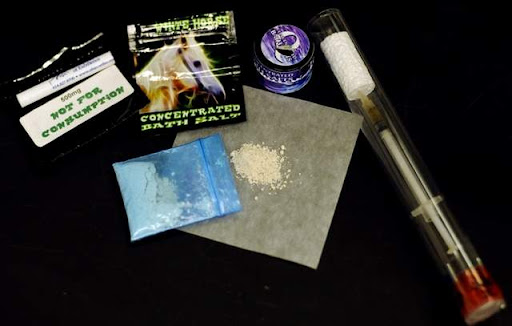 The U.S Drug Enforcement Agency's war on drugs continues with a nationwide ban of synthetic cocaine. Labeled as bath salts, the hallucinogenic drug has become more available in the Grand Junction area as part of a trend seen across the country. In response to increased emergency room visits, the federal agency has moved to emergency control these synthetic stimulants. This action makes it illegal to possess or sell Mephedrone, Methylenedioxypyrovalerone (MDPV), and Methylone or any products containing them for the next year. These chemicals are most often found in forms of 'legal ecstasy' or 'legal cocaine.' During the temporary ban, the DEA will team up with the U.S. Department of Health and Human Services to further study whether these chemicals should be permanently banned. In June, we introduced you to these bath salts in this article. Back then, they were an unregulated drug taking the place of recently banned synthetic forms of marijuana. "It is actually like a synthetic cocaine slash methamphetamine," Jim Schrant with the DEA told us at the time. "So, it's really the worst of both." The bath salts sell at a price of $40 per gram. They are mainly sold at smoke shops. But, in June, Schrant told us that his agency could not find any local dealers. Today, there are at least two. "They're putting it into packaging which is pleasing to the eye with market names of "Blue Dreams," things like that," Schrant said. "And, they're intentionally trying to target that young adult crowd." As part of this emergency control, businesses and citizens have 30 days to get rid of the banned products. At that time, the DEA will publish a Final Order in the Federal Register making the drugs Scheduled 1 substances. That category is the harshest and is reserved for unsafe, highly abused chemicals with no known medical use in the U.S. Violating that law is punishable by jail time. Employees at smoke shops in the area tell us that synthetic cocaine isn't that popular. But, local high school students have heard all about it. "I don't think they care if it's legal," Grand Junction High School freshman Hannah Rady said of some of her classmates. "Nobody does." Just like K2 and Spice, bath salts are labeled "not for human consumption." But, these students say that is not stopping anyone and neither is the law. "People just ask me 'Have you done spice before?' I'm just like, 'No,'" GJHS freshman Emilio Lazcano said. He knows Governor John Hickenlooper made those forms of synthetic marijuana illegal starting July 1, but he says fellow classmates continue to tell bother about it. "They're like 'Oh, well you're supposed to smoke it like this and that,' and I'm like 'Oh, well cool. I'm not really into that stuff.'" "They tell us that it doesn't make their eyes red, so it's way easier to bypass by your parents," GJHS junior Joe Gedscad added. The most common symptoms of these synthetic stimulants include impaired perception, reduced motor control, disorientation, extreme paranoia, and violent episodes. The DEA says the long-term physical and psychological effects are not known but potentially severe. Including Colorado, 33 states have already taken action to control or ban other synthetic stimulants. Most states pass these laws after the DEA files an emergency control on certain chemicals.
Monday, 12 September 2011
Rejuvenated Kinahan network 'back in trafficking'-

Sunday, 11 September 2011
Stars’ drug cartel links
POP queen Lady Gaga and Oscar-winning actor Jamie Foxx have been linked to the alleged bosses of an American drug cartel. Warren Braithwaite, 38, and Kevin Mucthison, 47, could be jailed for 50 years after they were charged with drug trafficking. They were arrested along with 20 others accused of smuggling marijuana worth £5million and distributing it in the US. Both have pleaded not guilty. Braithwaite’s interior design firm has carried out work at 43-year-old Foxx’s LA mansion. And Mucthison was a partner with Gaga, 25, for the 2009 launch of her Heartbeats by Lady Gaga headphones
Russian pilot gets 20 years in US jail
Konstantin Yaroshenko, a Russian citizen, has been found guilty of conspiring to smuggle cocaine into the US earlier this year and has been sentenced to 20 years behind bars. Yaroshenko, a pilot, was arrested in Liberia in 2010 and transported to America on charges of drug smuggling. The case itself sets a major precedent as it is the first time that a Russian citizen has been sentenced to a prison term in the US for intent to participate in a crime in a case that was built by special agents posing as drug dealers. Yaroshenko was arrested in a third country. The reaction from the Russian Foreign Ministry followed shortly afterwards. “The verdict of a US judge, who sentenced the Russian pilot to 20 years in prison on the accusation of conspiring to smuggle drugs into the US, raises some very serious questions,” says the ministry’s official representative Aleksandr Lukashevich. The ministry will continue providing assistance to the Russian pilot and will be working towards his repatriation, Lukashevich added. The Russian pilot’s defense team has 30 days to file an appeal but US officials might take as long as two years to consider any appeal. Yaroshenko repeatedly pleaded not guilty in this case, and the defendant and his family, who arrived in the US and was present in the court room to support him burst into tears as the sentence was announced. Konstantin Yaroshenko is a family man with no criminal background whatsoever and he has never previously stood trial. Moreover, he has never even set foot on American soil until last year when he was snatched by US special agents to stand trial. Neither Yaroshenko’s family nor the Russian authorities were informed of his arrest and no information was given to the Russian side as to his whereabouts, so he was considered missing. Russian officials say it is a breach of diplomatic conduct and a breach of international law and place the blame for all of this on the US State Department.
Saturday, 10 September 2011
Canadian truckie had 96kg of cocaine under floorboards
Canadian truck driver who pleaded guilty to smuggling cocaine under the floorboards of his truck was part of an operation that sent more than one tonne of drugs across the United States border into Canada since 2009, federal authorities said. Ravinder Arora, 30, of Brampton, Ontario, faces at least 10 years in prison at his December sentencing. Arora was about to cross the Lewiston-Queenston Bridge from western New York into Ontario last September when his nervous demeanour led US border agents to search his truck. They found 96kg of cocaine worth more than US$3.8 million ($4.5 million) in a compartment beneath the trailer's floor. It was believed to be the largest single narcotics seizure in the region's history. As part of a plea agreement, Arora admitted making four other trips and agreed to co-operate in the continuing investigation into what authorities believe is a larger smuggling operation. Two other people, including the owner of the trucking company that employed Arora, are awaiting trial.
Subscribe to:
Posts (Atom)